
Dallas vs New York City — Rapid Expansion Systems vs Vertical Infrastructure Saturation

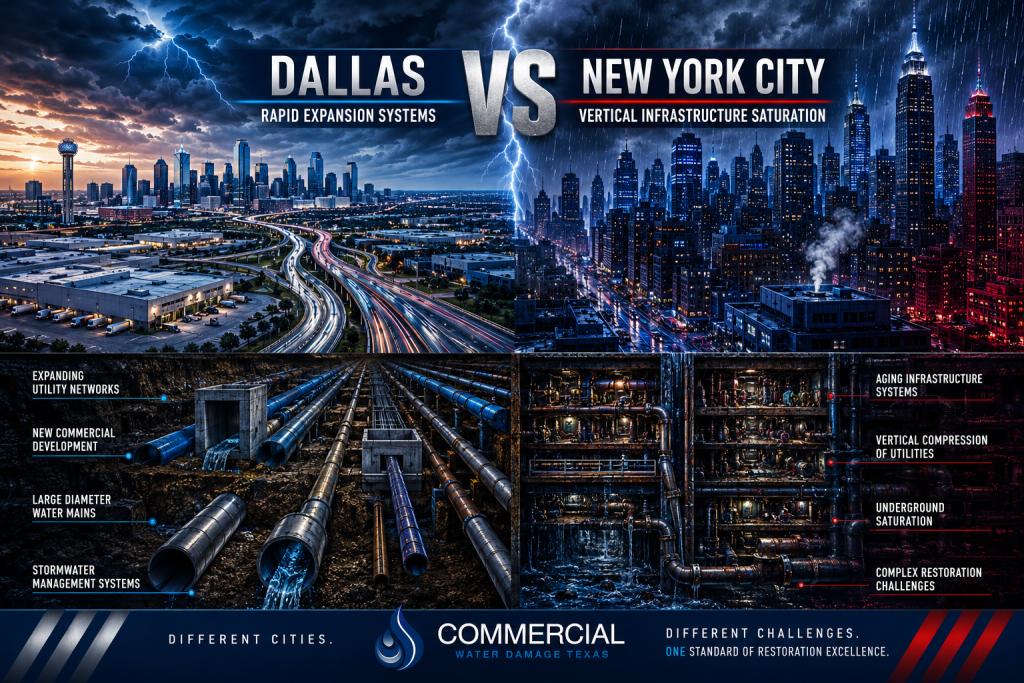
Urban infrastructure weakens differently under horizontal expansion than vertical compression.
North Texas continues spreading outward through massive suburban growth, industrial development, logistics expansion, and rapidly scaling utility systems across enormous land corridors.
New York City operates inside one of the world’s most vertically concentrated infrastructure environments, where density, occupancy demand, layered utilities, and aging structural systems create continuous operational saturation.
Both regions face significant commercial and residential infrastructure pressure.
Neither environment produces the same water damage behavior or structural fatigue patterns.
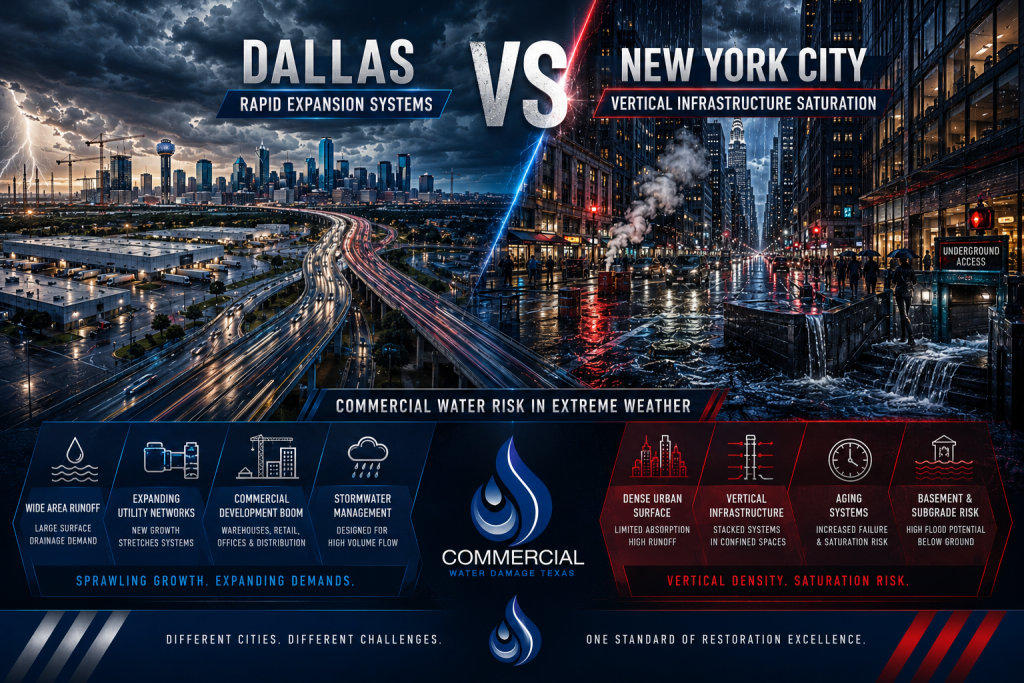
Dallas: Expansion Corridors And Growth-Driven Infrastructure Pressure
Dallas continues building outward at extraordinary speed.
Large residential communities, warehouse districts, healthcare campuses, multifamily developments, and commercial corridors spread continuously across North Texas.
Infrastructure systems must constantly expand to support accelerating demand.
Drainage coordination becomes increasingly difficult.
Stormwater velocity intensifies during severe weather activation.
Utility scaling pressures rise across rapidly developing zones.
Frequent Dallas-area infrastructure stress conditions include:
- Flash-flood drainage overload
- Foundation movement from expansive clay
- Commercial flat-roof ponding
- Underground utility shifting
- Stormwater retention failure
- Parking lot flooding
- Sewer demand imbalance
- Roof uplift exposure during severe storms
Rapid construction also increases long-term variability in grading consistency, drainage planning, and utility coordination.
Large commercial surfaces accelerate runoff concentration during major storm events.
Distribution facilities, industrial parks, and retail corridors remain especially vulnerable where drainage systems fail to scale alongside rapid development.
Storm-driven water intrusion often escalates quickly after severe weather activation overwhelms already stressed infrastructure.
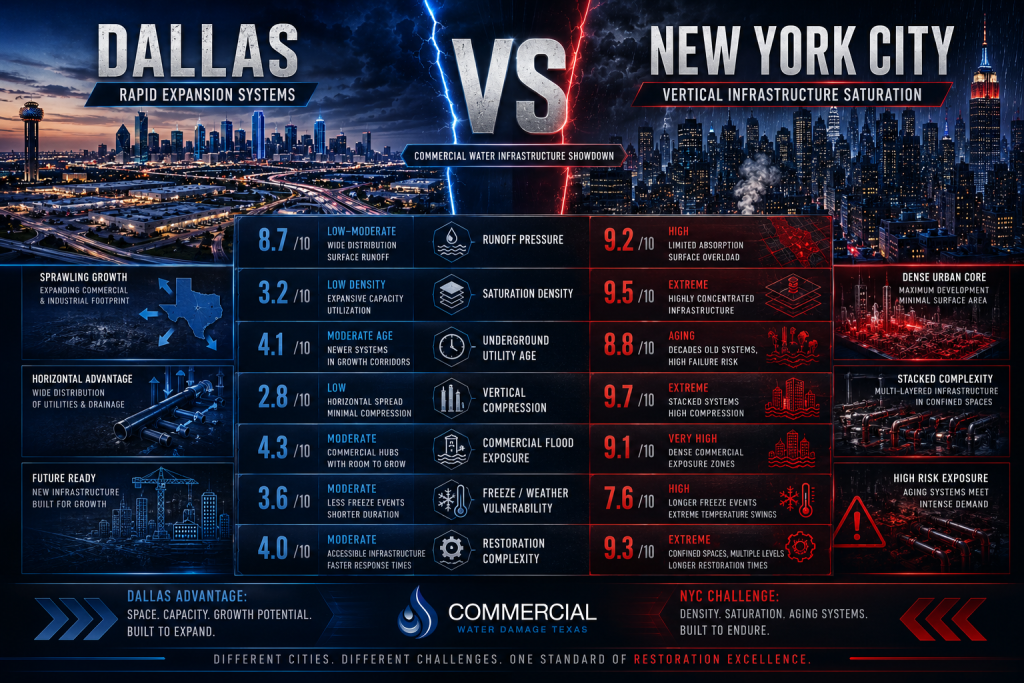
New York City: Vertical Density And Infrastructure Saturation
New York City infrastructure operates under an entirely different form of pressure.
Extreme density compresses residential, commercial, transit, utility, and mechanical systems into tightly layered vertical environments across all five boroughs.
Operational demand remains nearly constant.
Infrastructure overlap intensifies continuously.
Mechanical systems operate under relentless occupancy pressure.
Large portions of the city also rely on infrastructure networks developed generations ago and modified repeatedly over decades.
Common New York City infrastructure stress conditions include:
- Water main vulnerability
- High-rise plumbing pressure imbalance
- Basement flooding
- Drainage congestion
- Elevator mechanical exposure
- HVAC saturation inside dense towers
- Steam system fatigue
- Moisture migration through aging vertical assemblies
Vertical dependency significantly increases escalation risk when failures occur.
Water intrusion inside high-rise environments often spreads across multiple floors simultaneously.
Mechanical failures rarely remain isolated for long inside interconnected tower systems.
Older infrastructure also becomes increasingly difficult to modernize beneath constant occupancy and dense urban constraints.
Operational redundancy remains limited across many aging utility corridors.
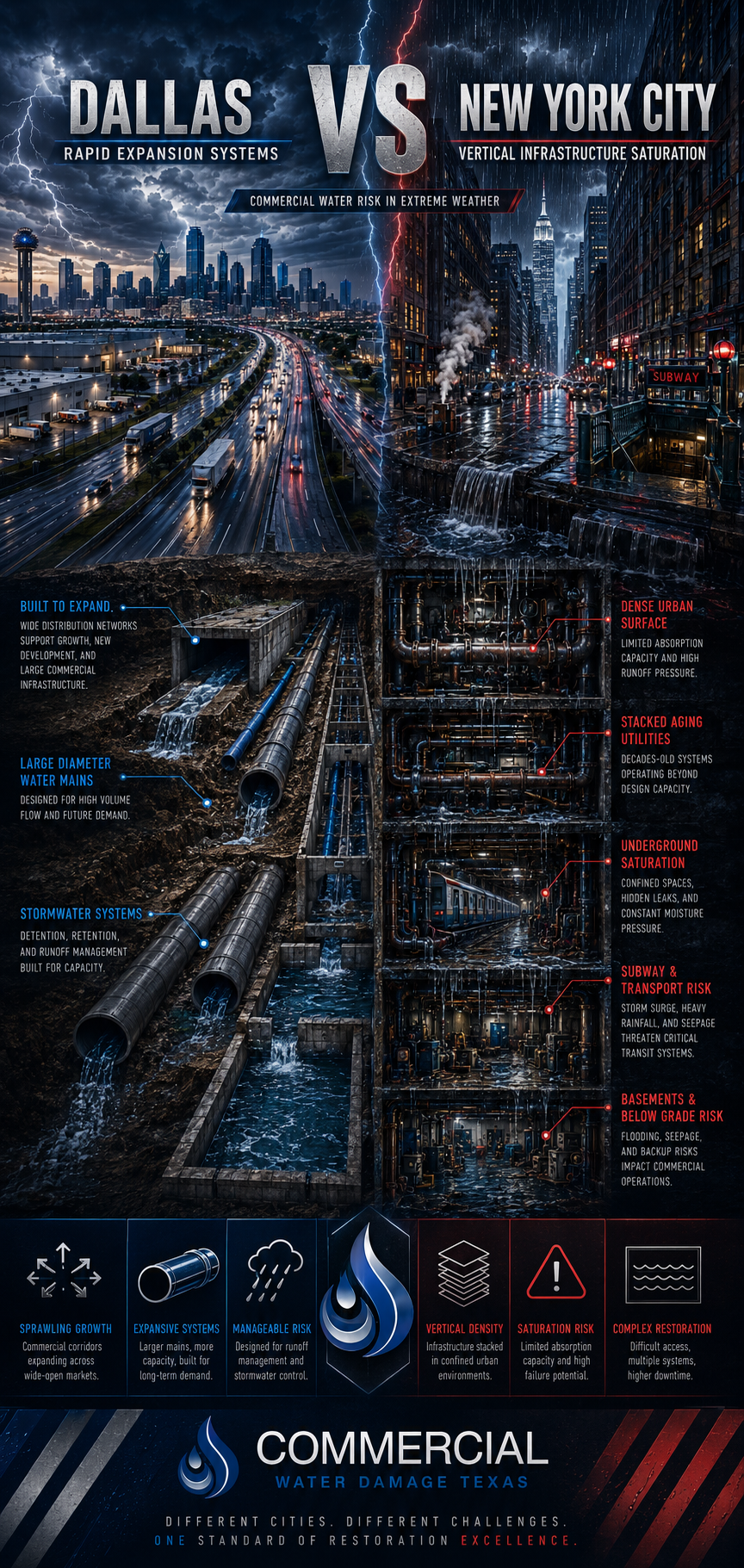
Horizontal Expansion Versus Vertical Compression
Dallas infrastructure commonly weakens through expansion speed and storm-driven environmental volatility.
New York City systems typically deteriorate through density saturation and continuous operational compression.
North Texas stretches infrastructure outward across rapidly growing land systems.
New York compresses infrastructure upward and underground inside finite urban space.
One region battles coordination pressure across expansion corridors.
Another region manages constant saturation inside layered vertical systems.
Different urban environments create different infrastructure vulnerabilities.
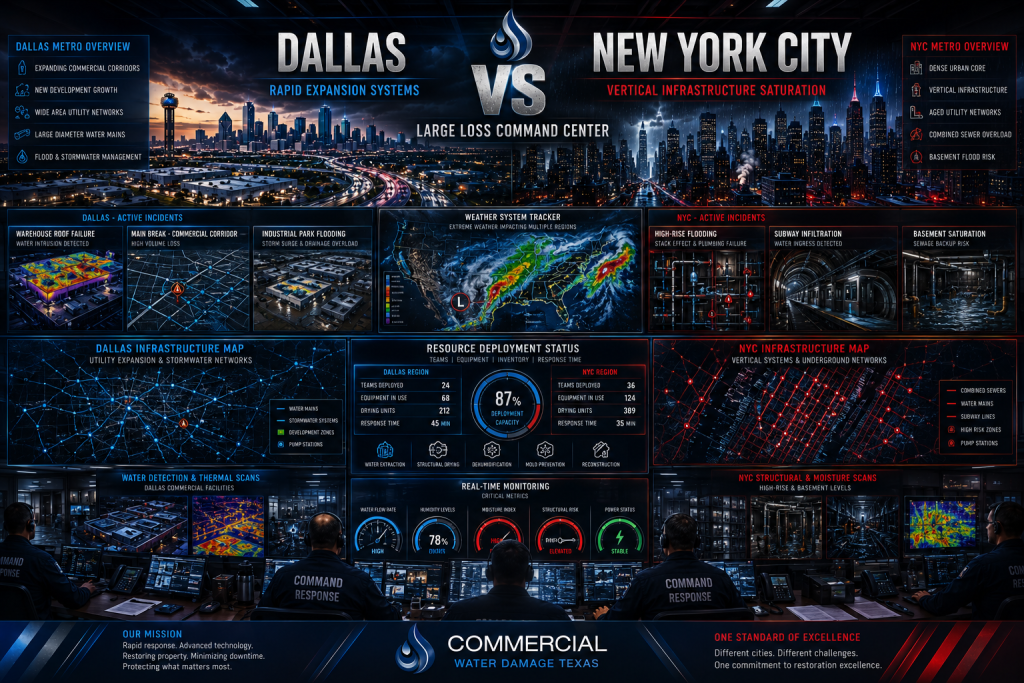
Commercial Water Damage And Operational Risk
Dallas commercial water damage frequently develops after severe storms overwhelm drainage systems, roofing assemblies, and retention infrastructure across large commercial properties.
Warehouses, logistics hubs, multifamily developments, and retail centers remain vulnerable during flash-flood activation and high-volume runoff events.
Water movement often accelerates rapidly across expansive commercial surfaces.
New York City commercial water damage commonly develops through pipe failures, vertical plumbing pressure imbalance, HVAC condensation issues, drainage congestion, and aging utility infrastructure inside dense occupied buildings.
High-rise leaks frequently affect multiple tenants simultaneously.
Mechanical system failures may disrupt entire building operations within short periods.
Emergency response also becomes more complicated inside vertically saturated commercial environments.
Access limitations increase recovery complexity significantly during major infrastructure failures.
Roofing And Exterior Envelope Differences
Dallas roofing systems primarily battle hail exposure, thermal expansion, UV degradation, and severe storm uplift pressure.
Large flat commercial roofs frequently experience drainage overload during sudden weather activation.
Stormwater accumulation increases ponding pressure around vulnerable roofing transitions and mechanical penetrations.
New York City roofing systems encounter prolonged moisture exposure, freeze-thaw cycling, wind-driven weather, and operational fatigue tied to dense vertical infrastructure environments.
Older buildings frequently contain aging waterproofing assemblies layered beneath decades of modifications and repairs.
Exterior façade systems also remain vulnerable where moisture migration develops slowly through masonry and high-rise envelope transitions.
Utility Infrastructure And System Demand
Dallas infrastructure continuously scales alongside rapid suburban growth and commercial expansion.
Utility coordination becomes increasingly difficult where development speed outpaces long-term environmental planning and drainage adaptation.
Storm activation frequently reveals weaknesses developing beneath accelerated construction conditions.
New York City utility systems operate inside one of the world’s most continuously stressed infrastructure environments.
Water, steam, transit, electric, communication, and drainage networks remain heavily layered beneath dense urban corridors.
Infrastructure maintenance rarely occurs without operational impact elsewhere.
System interdependence increases vulnerability throughout the city.
Failures often cascade across multiple connected infrastructure layers simultaneously.
Regional Infrastructure Reflects Regional Pressure
Urban systems respond differently to expansion than saturation.
Dallas requires resilience against severe weather volatility, runoff acceleration, expansive soil movement, and rapid infrastructure scaling.
New York City demands continuous adaptation within vertically compressed systems operating under relentless occupancy pressure and aging infrastructure complexity.
Different environments create different commercial and residential risk patterns.
Infrastructure behavior always reflects the environmental and operational systems surrounding it.
Failure progression begins long before visible damage reaches the surface.
