
Dallas vs Jacksonville — Texas Expansion Storm Systems vs Coastal Flood Exposure
Infrastructure stress develops differently across inland expansion corridors and coastal flood environments.
North Texas faces severe storm acceleration, sprawling suburban growth, expansive soil movement, and rapidly scaling infrastructure systems exposed to violent weather volatility.
Northeast Florida operates inside a coastal moisture environment shaped by hurricanes, tidal influence, groundwater saturation, and flood exposure across low-elevation development zones.
Both regions experience aggressive environmental pressure.
Neither climate creates the same infrastructure behavior.
 The Warehouse Roof That Becomes a Drainage System
A large Dallas warehouse roof can collect an enormous volume of water during a short, violent thunderstorm. Thousands of square feet of membrane suddenly begin directing runoff toward a relatively small network of drains, scuppers, leaders, and overflow points. Ponding near one restricted drain can turn an otherwise serviceable roof into the starting point of a major interior loss. Commercial roof replacement becomes worth evaluating when recurring drainage problems combine with deteriorated membrane, damaged insulation, failed seams, or widespread ponding. On large industrial properties, the roof should be viewed as part of the building’s stormwater system rather than simply the surface covering the structure.
Jacksonville’s Salt-Air Problem Continues After the Water Is Gone
Removing floodwater does not eliminate every consequence of a coastal commercial loss. Salt-laden moisture can reach door hardware, electrical components, mechanical equipment, metal framing, fasteners, storefront systems, and other assemblies long before obvious corrosion becomes visible. Commercial water damage repair in coastal environments therefore requires attention to materials that may have been exposed even when they remain physically intact. Equipment rooms and concealed cavities deserve particular scrutiny because residual moisture can remain trapped after occupied areas appear dry. Jacksonville recovery becomes a question of what the water contacted, not simply how high the water reached.
Dallas Soil Movement Can Turn Plumbing Into a Building-Wide Problem
The same expansive soil movement that affects North Texas foundations can place stress on plumbing running beneath or through commercial structures. Slight movement around slabs, utility penetrations, buried lines, and building connections may create vulnerabilities that remain unnoticed until a later failure releases water. Large retail centers, warehouses, offices, and industrial properties make the investigation more complicated because the visible damage may be far from the compromised line. Commercial plumbing and tenant-improvement contractors can become important during reconstruction when damaged utilities must be accessed beneath finished building areas. In these situations, repairing the pipe is only one part of understanding why the failure occurred.

When a Jacksonville Storefront Becomes Part of the Storm
Coastal wind can drive rain against commercial façades from directions the building rarely experiences during ordinary weather. Storefront framing, entrance systems, curtain walls, perimeter joints, glazing gaskets, and transitions between different exterior materials can suddenly become part of the water-control system. A commercial glazing contractor may need to investigate repeated intrusion when water appears around retail entrances, hotel façades, office windows, or large expanses of architectural glass. The failure may involve the glass system itself, adjoining construction, or the interface where separate envelope assemblies meet. That makes coastal leak investigation considerably different from replacing a visibly broken pane after a storm.
Two Cities, Two Very Different Drying Clocks
Dallas and Jacksonville can experience similarly large commercial water losses while requiring very different assumptions about what happens afterward. Hot North Texas conditions may create aggressive evaporation at exposed surfaces even while moisture remains trapped beneath flooring or inside insulated assemblies. Jacksonville humidity can work against the drying process by reducing the ability of wet building materials to release moisture into already moisture-heavy air. Structural drying decisions should therefore respond to actual material readings, indoor conditions, assembly types, and moisture migration rather than a predetermined number of drying days. The building—not the calendar—should determine when mitigation is complete.
 The Moment Restoration Becomes Capital Improvement
A major loss can expose building problems that existed long before the storm arrived. Aging ceilings, inefficient layouts, obsolete lighting, undersized electrical distribution, dated HVAC zones, damaged flooring, and old office partitions may all become visible once demolition begins. TI build out contractors can help owners separate insurance-driven reconstruction from improvements that make sense while walls and ceilings are already open. Dallas properties undergoing rapid expansion may use that opportunity differently from Jacksonville buildings adapting to repeated coastal exposure. The smartest reconstruction plan distinguishes what must be restored from what should finally be redesigned.
Dallas Speed Versus Jacksonville Duration
Large-loss planning changes when the primary threat is measured in hours rather than days. Dallas thunderstorms can overwhelm roof drainage, parking lots, loading areas, and stormwater infrastructure with remarkable speed, creating several simultaneous entry points across a commercial property. Jacksonville tropical systems may expose the same building to repeated rain bands, elevated groundwater, wind-driven moisture, and drainage limitations over a much longer period. Emergency restoration planning should account for these different failure timelines because equipment placement, access, containment, moisture monitoring, and operational decisions can change as the event develops. Two buildings with comparable square footage may therefore require completely different response strategies despite showing similar water depths when crews first arrive.
Dallas Storm Runoff and Commercial Drainage Pressure
Dallas continues expanding across enormous residential, industrial, and commercial corridors throughout North Texas.
Large-scale development dramatically increases impervious surface coverage across roads, parking systems, warehouses, and suburban neighborhoods.
Stormwater velocity rises quickly during severe weather activation.
Drainage demand expands continuously.
Infrastructure coordination becomes increasingly difficult across fast-growth environments.
Frequent Dallas-area infrastructure stress conditions include:
- Flash-flood runoff acceleration
- Roof drainage overload
- Foundation movement from expansive clay
- Stormwater retention failure
- Underground utility shifting
- Sewer pressure during major storms
- Commercial flat-roof ponding
- Parking lot flooding across retail corridors
Severe thunderstorms frequently produce sudden high-volume rainfall capable of overwhelming vulnerable drainage systems within short periods.
Expansive clay further destabilizes infrastructure beneath rapidly developing suburban environments.
Dry conditions shrink soil support around foundations and buried utilities.
Heavy rainfall then rapidly rehydrates surrounding ground zones.
Repeated expansion and contraction place continuous stress on slabs, plumbing systems, and commercial infrastructure alignment.
Storm activation often exposes weaknesses developing beneath accelerated construction conditions.
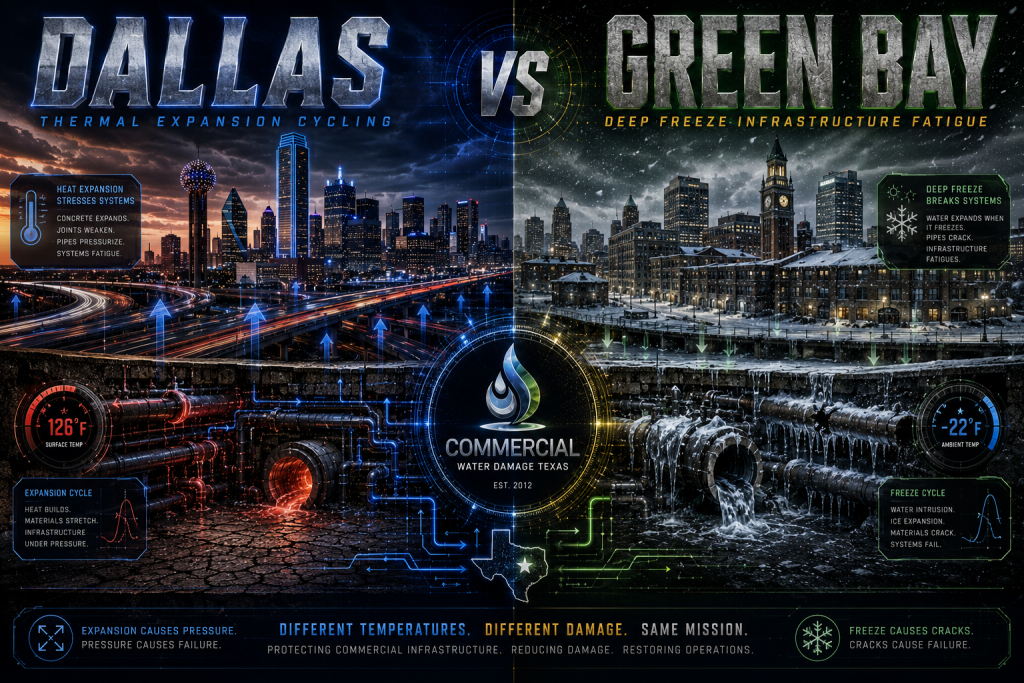
Jacksonville Coastal Flooding and Storm Surge Exposure
Jacksonville infrastructure operates inside a fundamentally different environmental system.
Atlantic storm exposure, elevated groundwater conditions, tidal influence, prolonged humidity, and hurricane-related flooding create persistent moisture pressure across residential and commercial environments.
Water retention remains highly influential throughout the region.
Drainage movement slows significantly across low-elevation areas.
Subsurface saturation persists longer after major storms.
Common Jacksonville-area infrastructure stress conditions include:
- Coastal flooding
- Storm surge intrusion
- Crawlspace moisture accumulation
- Foundation saturation
- Corrosion around metal systems
- Roof moisture retention
- Mold amplification inside enclosed spaces
- Drainage backup during tropical systems
High groundwater levels also increase vulnerability beneath homes, multifamily properties, and commercial structures throughout the region.
Heavy rainfall frequently interacts with already saturated soil systems during hurricane season.
Salt-air exposure further accelerates corrosion across coastal infrastructure and mechanical assemblies.
Commercial environments near waterways remain especially vulnerable during prolonged storm events and tidal surge conditions.
Water intrusion often develops through persistence rather than sudden atmospheric shock alone.

Storm Expansion Versus Coastal Saturation
Dallas infrastructure commonly weakens through runoff acceleration and severe storm volatility tied to rapid expansion pressure.
Jacksonville systems typically deteriorate through long-duration moisture exposure and coastal flood saturation.
North Texas stresses infrastructure through violent weather intensity and fast-moving runoff systems.
Northeast Florida fatigues infrastructure through groundwater pressure, humidity persistence, and tidal moisture retention.
One region overwhelms systems rapidly.
Another region saturates systems continuously over time.
Different environmental systems create different infrastructure vulnerabilities.
Commercial Buildings And Water Damage Risk
Dallas commercial properties frequently experience water intrusion after severe storms overwhelm roof drainage systems, retention infrastructure, and large paved commercial surfaces.
Industrial facilities, warehouses, and retail environments remain highly vulnerable during flash-flood activation.
Stormwater movement escalates quickly across expansive commercial corridors.
Jacksonville commercial infrastructure faces elevated flood exposure from coastal storms, prolonged rainfall, groundwater migration, and storm surge pressure.
Hotels, multifamily systems, healthcare facilities, and waterfront commercial properties remain especially vulnerable during tropical weather activation.
Persistent dampness also increases long-term microbial growth risk across enclosed commercial environments.
Operational disruption frequently expands slowly beneath prolonged moisture exposure conditions.
Roofing And Exterior Envelope Differences
Dallas roofing systems primarily battle hail impact, thermal expansion, severe storm uplift pressure, and rapid runoff accumulation during high-intensity weather events.
Flat commercial roofs frequently experience ponding stress during sudden rainfall surges.
Jacksonville roofs encounter prolonged humidity, salt-air corrosion, wind-driven rain, and continuous moisture retention throughout much of the year.
Coastal storms repeatedly stress waterproofing systems, flashing assemblies, and exterior penetrations.
Drying cycles also slow significantly under persistent humidity conditions.
Exterior deterioration commonly develops gradually before visible intrusion appears.
Foundation And Ground Movement
Dallas foundations regularly shift due to expansive clay cycling beneath rapidly growing suburban environments.
Alternating drought and rainfall periods repeatedly alter subsurface support conditions around slabs and underground utilities.
Jacksonville foundations confront pressure from groundwater saturation, soft coastal soils, and prolonged moisture retention beneath structures.
Low-elevation terrain increases flood vulnerability during major storm events.
Subsurface dampness frequently persists long after visible surface water recedes.
Ground movement develops through different environmental mechanisms in each region.
Structural stress remains the shared outcome.
Utility Infrastructure And Operational Demand
Dallas infrastructure continuously scales alongside rapid suburban growth and commercial development expansion.
Storm activation frequently exposes coordination weaknesses developing beneath accelerated construction environments.
Drainage systems remain under constant pressure during severe weather cycles.
Jacksonville infrastructure operates under continuous coastal exposure and hurricane-season operational demand.
Flood control systems, drainage networks, and utility infrastructure remain heavily stressed during prolonged tropical weather events.
Salt-air corrosion and groundwater saturation further accelerate long-term utility deterioration across vulnerable coastal corridors.
Operational strain accumulates gradually beneath persistent environmental exposure.
Regional Climate Shapes Infrastructure Reality
Storm corridors influence infrastructure differently than coastal flood environments.
Dallas properties require resilience against runoff acceleration, severe weather aggression, expansive soil movement, and rapid development pressure.
Jacksonville infrastructure demands flood mitigation, moisture management, corrosion resistance, and long-term adaptation to coastal saturation systems.
Different climates create different infrastructure realities.
Failure progression always reflects the environmental systems surrounding the structure.
Regional pressure shapes structural behavior long before visible damage appears.
